


MARNE 1918 - Friedensturm
Game - History - Map - Counters
History
At the beginning of 1918 the situation on the western front is a stalemate. But for the first time since 1914, the Germans are in numerical superiority thanks to the troops transferred from the east after the collapse of the Russian front. Taking advantage of this superiority and using revolutionary tactics, the Germans launch a series of offensives - Michael and Georgette - against the British in March and April 1918 with spectacular results, temporarily putting them out of action.
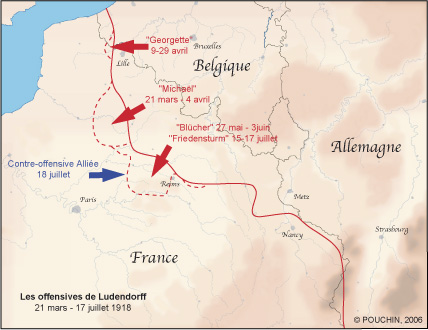
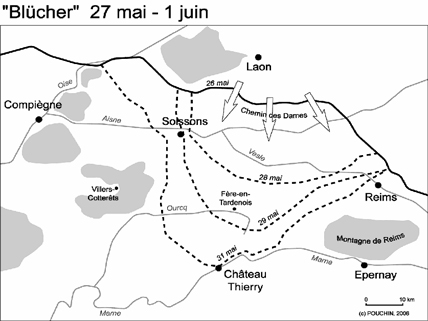
Ludendorff decides to strike his next blow against the French, along the Chemin des Dames where the French had failed in their own offensive one year earlier. It is known as a quiet sector, with a relatively low troop density, including in particular some English divisions recuperating after having suffered heavily during operation Michael two months earlier. In the middle of the night of the 27th of May the German assault waves move out from their trenches, preceded by small groups of stosstruppen. They rapidly overwhelm the allied troops, stunned by the massive artillery bombardment orchestrated by colonel Bruchmuller. The French high command is slow to react, massing troops in the front line and waiting too long to blow the bridges over the Aisne river, which are captured intact by the Germans. The allied front line collapses on the first day as the Germans advanced deeply, over 50 km in a few days. The arrival of allied reinforcements, including two US divisions, will finally stop the German offensive on the Marne.
A salient remains between the areas of the Michael and Blücher offensives. On June 9th, Ludendorff launches the Gneisenau offensive aiming to reduce this bulge and to seize the rail junction at Compiegne. Von Hutier's XVIIth army wins some initial successes and crosses the river Matz. But this time the French are not taken by surprise, thanks to George Painvin having broken the German codes and deciphered a vital message a few days earlier. This "victory radiogram" allows the French high command to send Mangin's Xth Army which stops the German advance quickly, thus saving Compiegne.
Fighting continues throughout June, aiming at widening the bulge. In particular, the wood of Belleau will be the theatre of bloody confrontations. For 4 weeks, the Germans try to make break the green US troops, but without success. As a result of this battle, US morale increases considerably, at the price of terrible losses.
Feeling final victory eluding him, Ludendorff prepares the Peace offensive: Friedensturm, which aiming to encircle Reims, a highly symbolic place where all frnch kings had been crowned. Beginning on July 15 with enormous means, it runs up against a French Army whose tactical doctrines have made more progress in 2 months than in the 4 previous years of conflict. General Gouraud, head of the 4th French army deploys in depth, following the new Pétain doctrine. The Germans are massacred on the second line of defence. Only the German western pincer obtains some success on the Marne and in the forest of the mountain of Reims, but Friedensturm's goals are soon reduced to capturing Epernay.
But the German failure becomes complete when on July 18, the Franco-American troops launch a series of large counter- attacks. Preceded by 500 tanks and supported by numerous planes, the allies recover little by little the ground lost in May. At the end of July, they are back on the Soissons-Reims line, having thus won the decisive battle of the war. They will not stop before November 11th.